
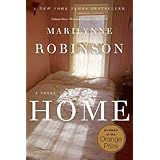
 Home, by Pulitzer Prize winning author Marilynne Robinson, starts off slowly and never accelerates. That's just fine by me. Reminiscent of Faulkner's artistry to reveal secrets quickly but after much waiting, Robinson makes sure that her readers get to know Jack, Glory, and their father before she reveals any of their secrets--most of which you'll already have guessed. Like Faulkner, the emphasis lies not with the plot but with the characterization. And one of the prominent characters is the Presbyterian religion.
I don't know much about Presbyterianism. I know a lot about Catholicism, a little bit about Islam, and a little more about Buddhism. So reading Home, I repeatedly found myself asking my Baptist-born, Bible-doctorate husband questions which started with, "Do Presbyterians believe in...?" Unfortunately, I didn't gleam the information I needed to understand my central problem with the book--self-sacrifice. Specifically, I object to touting self-sacrifice as self-actualization.
Before I object to the ending, I do want to recommend this book for its take on female self-actualization. Its implied author seems to authentically struggle with how we can be gracious, generous, hospitable, forgiving, tolerant, and ethical without destroying our own chance of happiness and enhancement. Glory and Jack both struggle with these issues. Their father, less so. Up until the end--which I prefer not to give away--their struggles are genuine and, therefore, unmistakably flawed. They afford kindness and deny it. They rise above their situations and become mired in them. I became so tired of Jack's pity party until I got to know his father better. All old age and religious excuses aside, the guy's toxic. I began to understand that if he were my father and I'd not followed the religious and social parameters of his household, I would have also gone astray and felt alienated. For each ethical dilemma that Jack, Glory, and their father encounter, there are no easy (or perhaps even, right) answers. These are struggles that, based on irreversible past actions, rely on altering one's mind, not one's situation. For my money, these Presbyterians could have used a dose of Buddhism or Stoicism.
The beauty of reading the book for me was witnessing how Jack and Glory (their father, not so much) struggle to negotiate amid a strict worldview based on a complicated combination of perdition and grace. Witnessing their struggles afforded me important self-actualizing questions: After ruining somebody else's life, can I ever hope to live a full life? Or is that hope unfair? Can I privilege my beliefs over charity, and feel righteous? Is it more important to be right or be about the relationship? When is it time to extract myself from toxic family relationships? Can I ever turn off those parental voices in my brain? Home evolves these questions, often leaving them unanswered, but still exploring them sincerely.
That is, until the ending when it seems that the one and only redemption we can all embrace is self-sacrifice. Glory, contrary to what Jack advises her, chooses to sacrifice her life for a fantasy--for the good of someone she has just met and, ironically, who will likely never benefit from her self-sacrifice. Forget about religion. That's just a waste. Enough said.
But extract that unnecessary and destructive ending, and I totally endorse this book, which struggles with female self-actualizing--to know/accept oneself better, to eschew debilitating external pressures, and to participate in someone/thing bigger than oneself. Glory does all of that--until her final decision.
Good reading!


No comments:
Post a Comment
Note: Only a member of this blog may post a comment.