Here's to all strong women...

Here's to all strong women...
dedicated to my mother, aunt, sister, cousin, nieces, daughters, step-daughter, and granddaughters

Sunday, February 26, 2012

Self-actualization Through Work in Jade Snow Wong's Fifth Chinese Daughter


Let's continue our study of Jade Snow Wong's Fifth Chinese Daughter by considering how work affects this female's self-actualization. From early childhood through her post-college years, Jade works hard, saves fervently, and develops self-pride in her financial independence. More than cultivating a firm work ethic, Jade finds outlets for her creativity and establishes independent of the Chinese American restrictions for females.
At an early age Jade lives with her family at the back of the factory they own, mixing home and work lives. As as “Christian,” Father allows Jade's mother to labor at a machine most of the day, in addition to her domestic and parenting responsibilities.1 Maybe that rationale makes sense to you, not so much to me. Mother bitterly tells the story of raising her mother’s pigs without any recompense. For her, working hard is just working hard. At age 11, the Depression forces mother to worker loinger factory hours and Jade to run the household. Her father rejects government relief so the children will learn to work for whatever they gain. Jade’s chores glean her fifty cents per week, plus an addition fifteen for cleaning her brother’s room. She saves forty dollars by the summer’s end. At an older age, she works in seven homes of her choosing. Her “entire fortune” grows to $167.68. At college, she estimates that she can work in Berkeley to pay her expenses. She seems destined to achieve, albeit slowly, the American Dream—not the Chinese American dream for women—until she encounter a Caucasian male who warns, “If you are smart, you will look for a job among your Chinese firms. You cannot expect to get anywhere in American business houses. After all, I am sure you are conscious that racial prejudice on the Pacific Coast will be a great handicap to you” (188). 2
Determined as always, Jade sets out to learn “about the American work world—commonly known as ‘a man’s world” (192). Bored at work, she investigates the effect of vaccine programs; and is asked to continue her research as a full-time job in which she gains “confidence in dealing and working with the men” (194) who gradually come to respect her as she loses her shyness. Her prize-winning essay on the vaccine program is incorporated into a Presidential congressional report and she is chosen to christen the William A. Jones, amidst photographers and journalists. This is a big deal. But back to work as a secretary, she returns to menial task because, her boss explains, “...as you are a woman, you can’t compete for an equal salary in a man’s world?” (234).3 Readers may be reminded that “Simone de Beauvoir believed adolescence is when girls realize that men have the power and that their only power comes from consenting to become submissive adored objects. They do not suffer from the penis envy Freud postulated, but from power envy” (Pipher 21). Katharine Hanna explains that “Jade Snow Wong realized that there was no future for a young Chinese woman in the military or corporate world. Characteristically, she takes another step into the unknown—doing what she loves most—potting (as in pottery making) and writing” (10). This becomes the turning point in her working life and in her self-actualization.
Jade decides to write because “[i]In writing, a woman would not be competing against men. Of course, she had no assurance of success in writing about the life and heart of the Chinese people, but that did not convince her that she shouldn’t try” (235). Her attraction to pottery and writing becomes the freedom it affords her: “She could call her soul her own, strike her own tempo as she carved her own niche” (236). She joins the Ceramic Guild, constructs over three hundred pottery pieces, and decides to start her own business. Wong records, “After World War II ended, having worked in American corporate offices, I knew that a young, Chinese female could never rise to the top in white male-dominated fields. Since I had learned to love making pottery why couldn’t I make a living at it? For my whole life, I had been bound by the tenets of Chinese culture . . .” (Gerry Wong 28). Sitting in a storefront window in Chinatown, she attracts many spectators. A newspaper article declares “that she had invented a new mousetrap” (244). “Chinatown was agog. A woman in the window, her legs astride a potter’s wheel, her hair in braids, her hands perpetually messy with sticky California clay, her finished products such things as coolies used in China, the daughter of a conservative family, running a business alone—such a combination was sure to fail!” (244). Can you imagine the sight? Other store owners chide, “Look, here comes the mud-stirring maiden” (244). Although her Chinatown neighbors deride, “Caucasians came from far and near to see her work, and Jade Snow sold all the pottery she could make” (244). However, no Chinese came to buy one piece. Even without their support (like her parents' non-support), in only three months, she accumulates enough money to buy and drive “the first postwar automobile in Chinatown” (244).4 Imagine that sight. How does she manage to become so successful amidst such a patriarchy? First, she rebels against the forced acculturation of her Chinese parents who refuse to fund their female daughters' college education. She rebels by working hard to secure a financial base and academic success—not through a sense of bravado but through a sense of practicality. She starts at the junior college level and chooses her 4-year college based on their full scholarship offer. She is realistic but highly determined to achieve success—financially, artistically, and personally. Her quiet, focused, and relentless rebellion against her parents and her neighbors establishes a self-actualizer's need to color outside the box if the box confines.
However, not everyone judges her work ethic so positivel. The debate about the merits of Jade Snow’s working life centers on her pottery business. While I have argued (and some critics agree) that Jade works hard and deserves the success she achieves, others contend she becomes a capitalistic accomodationist. These critics, with Frank Chin in the forefront, berate Jade's concession to sit as an object in a Chinatown storefront window, crafting pottery for tourists, and selling every piece only to non-Chinese Americans. Sitting in the storefront window “playing with mud” in Chinatown, certainly Jade becomes a curiosity. Gang Yue sees this as Jade “offering herself up for the American feast” (351). Further, he reflects that, “The desire to assume the role of a cultural ambassador is dispersed in her narrative development from an innocent eater to a curious item palatable for cultural consumption” (351). Having grown up in a family always consumed with financial stability and achieving her own successes through hard work, readers can not doubt the importance of self-sufficiency for Jade. However, these critics, and others, view her success as a loss of self and denial of culture. Jeffrey J. Santa Ana explains, “For people of color, women, and sexual minorities in the United States, assimilation into the culture of neoliberalism entails desiring a consumption-based subjectivity that recasts political rights as economic liberties and reduces diversity and difference to superficial style for sale in the market” (16). Santa Ana references Alexandra Chasin’s contention that “the market promotes assimilation into a homogenous national culture, encouraging identity difference only to the extent that it serves as a basis for niche marketing” (xvii) (Santa Ana 16).5 Working in front of and selling to only Caucasians, Jade receives criticism for “selling out” and catering to the “consumer culture’s image of stylized race and ethnicity,” thus premising citizenship on “a shared culture of consumption that denotes feelings of enfranchisement and oneness with mutual consumerism in globalization” (19). In this way, Jade attempts to create and sell her pottery are construed as attempts to fit in, not as a Chinese North American but as a non-Chinese North American. Bow concludes, “The text’s implicit endorsement of capitalism performs an ethnic normalizing function by testifying to Chinese American adherence to a fundamental aspect of American norms and attitudes. But the text bolstered more than domestic ideology; the autobiography served the interests of foreign policy by lending credibility to a historically necessary representation: the good Chinese as capitalist” (86). For these critics, Jade embraces capitalism and a Caucasian market, which computes financial success as cultural assimilation.
On the other hand, some critics applaud her gumption, determination, and savy. Culturally, Lai notes, “We are told we have overcome our oppression, and that therefore we are the model minority. Model refers to the cherished dictum of capitalism that ‘pulling hard on your bootstraps’ brings due rewards. The lesson drawn is that if you work hard enough, you will succeed—and if you don’t succeed, you must not be working hard enough” (182). Typical Puritan work ethnic. This is a good match for Jade who has been brought up on the pride of hard work with illustrations from her family, including Uncle Kwok. “By establishing her own American business while retaining her Chinese identity, and by winning American clientele in San Francisco’s Chinatown, Jade Snow is continuing her search for a way to balance the two cultures” (Zheng 27).
This study agrees with Yin and Paulson’s position that Jade does not capitulate to American middle-class values. “Rather, she continues the best of Chinese culture and rejects the worst. Similarly, she assesses American culture”(56) while not rejecting Chinese cultural values. Jade realizes full well that as a woman and as a Chinese North American, she is trapped amidst many stereotypes attempting to prevent her financial status and success.6 If working hard has not granted her recognition, approval, and financial support by her Chinatown neighbors, then, it is no wonder that Jade pursues “acceptance into white society, on American terms” (Grice 5). She had learned from her pottery instructor at Mills College to persist, to learn through error, and to progress to more demanding techniques when one is mastered (Kathleen Hanna Jade Snow Wong: A Restrospective). F. Carlton Ball’s potter advice to perfect old methods and explore new techniques stands as a metaphor for Jade in all of her work endeavors. As a writer, she refashions Chinese value of deference through the use of the third-person narrator with the “American” value of autonomy. As a researcher, she relies on the Chinese value of the thoughtful herbalist with the “American” value of innovation. As a potter, she adapts Chinese methods and styles for a tourist market. Obviously some critics determine this blending in Fifth Chinese Daughter as an “overt accommodationist message” (Bow 91). However, this study commends the text as a practical and inspirational self-actualization message of both US and Chinese US values of self-reliance and career success.7 Simply put, Jade learns to adapt to two cultures through hard work and creativity.
When we last leave Jade, she is poised to continue her self-actualization, first, as a State Department tour guide and second, as a potter at local art festivals. With abiding respect for her Chinese family and neighborhood, Jade accepts what they have and haven't given her, as well as responsibility for her own financial status and creativity. Through her work—jobs and artistic endeavors—Jade rejects unhealthy patriarchal assimilation but maintains family/cultural work values. Like every self-actualizer, she becomes a highly selective person, in this case, pursuing the careers that embolden her passions. Although creative careers, they don't isolate her; Jade doesn't become the recluse artist. Contrarily, through leading tours, writing, and potting, Jade develops her own interests and confidence while connecting with others. This combination of self-fulfillment and social connection assures that the self-actualizer eschews narcissism and participates in a cause greater than herself.
How much improved our human interactions would be if we established who we are and who we are becoming after we established our place in a world with others. Instead of trying so badly to fit in to a prescribed cultural agenda—like the romance—we reassess how that agenda fits us while engaging us to help someone else. Thereafter, we know whether to subscribe to it, tweak it, or reject it. We don't automatically walk to a different drum beat or take the road less taken. We don't fancy ourselves as special or different or entitled. Rather, we charge ourselves to become the best person we can be. And if a system allows us to excel, we're free to participate in it—adopting that religious creed, voting for that candidate; contributing to that organization, or joining that support group. But if the system stifles our ability to know, accept, and improve ourselves, then we must reject it not just because we'll excel but also because that's the only way to contribute to others' lives. We must always remember that self-actualizing is more like Aristotle's eudaemonia than the modern world's concept of self-fulfillment: self-actualizers live an ethical life—contributing to something or someone(s) other than themselves. They deliberating choose their contribution—not as a sacrifice or noble deed—but as their passion. In short, they combine their “want” and “should” lists, which ensures that replicates the ancient Greeks' belief that living an ethical life is the only way to live a happy life.
1 Tracy Lai notes that “Asian American women are also stereotyped as having special dexterity and endurance for routine, thus making them fit for assembly work . . . ” (187)

2Lai explains, “Businesses want docile, subservient workers… Many businesses purposely seek immigrant workers with limited English skills as further insurance against backtalk” (187).
3 According to Leslie Bow, “Wong’s stance is in keeping with the resurgence of domesticity following the war: she does not see traditional ‘woman’s work’ as limiting; rather, domestic and secretarial work are catalysts for her entry into the white world. As Wong has stated, ‘Though I don’t think being a woman has been any problem, I give priority to women’s responsibility for a good home life; here, I put my husband and four children before my writing or ceramics’ (cited in Contemporary Authors `09: 536)” (82). Bow contends, “The text positions women’s autonomous selfhood as something to be individually earned: equality is not necessarily open to all women, but only to those who prove themselves as equal to men through their achievements” (80).

4 Victoria Eng confirms that after Wong’s graduation with a B.A., because “an autonomous businesswoman” (Eng 1260). Later, “Wong married a fellow Chinatown native and artist, Woodrow Ong, and they began to collaborate on their work” (Gerrye Wong 28).


5See: Chasin, Alexandra. Selling Out: The Gay and Lesbian Movement Goes to Market. New York: St. Martin’s Press, 2000.
6Lai acknowledges, “A capitalist society means that a few will profit while the majority will not. Feminism must deal with the structure of capitalism and its exploitation of people by race and class, as well as the way this exploitation parallels and compounds women’s oppression” (Lai 189).

7 “Asian culture is more, not less, individualistic than Western culture. The proof: Asian childhood literature and history” (Frank Chin 9).

Wednesday, February 22, 2012

Self-actualization Through Education in Jade Snow Wong's Fifth Chinese Daughter

 Written in the third person, Fifth Chinese Daughter reveals the self-actualizations of both the younger Jade character and older Jade Snow Wong narrator. I'd like to consider how education—formal and informal—plays a big role in Jade's self-actualizations, specifically her self-acceptance and resistance to forced acculturation.
Informally, at home, Jade's early “education” is mostly painful, starting with the annual arrival of the rice barrel, which provides not only their main food staple, but also Father's yearly switch supply. Capital punishment abounds in the Wong household. Bad enough. Worse, no explanations accompany the whippings. So little children are left to wonder what they did wrong. Understandably, Brother dreads the barrel's arrival but, like his siblings, suffers without complaint. It seems that Father's capital punishment guarantees filial piety. However, our older narrator ends the chapter “Learning to be a Chinese Housewife” with Jade as a little child, avoiding eating rice (twice a day) to forestall the next barrel's arrival. Recounting such self-deprivation, Jade Snow Wong signifies on her father's abuse and builds the case for Jade's later detachment from her father's iron will. (See Henry Louis Gates' Jr.'s The Signifying Monkey.)
Uncle Kwok, a janitor and factory worker, more positively influences Jade's self-actualization. Although she considers him peculiar, Jade continues to watch his lifelong scholarship of Confucian classics in hopes of becoming a private tutor. Uncle Kwok prefigures her grandfather, who also values informal education. Autodidacts model the examined life that can lead to self-understanding and potentially, self-acceptance. From Uncle Kwok, Jade sees an example of private study, which will serve her well not only in college but thereafter, as an artist and writer.
And what of her home education? Father announces to his 3rd grade daughter that being a girl, she need not worry about college. Conveniently, is code relieves him of financial support. As her high school graduation looms, he elucidates that the sons “perpetuate our ancestral heritage by permanently bearing the Wong family name and transmitting it through their blood line, and therefore the sons must have priority over the daughters when parental provision for advantages must be limited by economic necessity” (108-109). Notice how that nonjudgmental report changes with Father's own words: “If you have the talent, you can provide for your own college education” (109). Then, overtly Jade Snow Wong criticizes: “. . . his answer tonight left Jade Snow with a new and sudden bitterness against the one person whom she had always trusted as fair to her” (109). We have moved from signifying on Jade's early disappointment to condemning Father's decision, authority, and character. However, we don't know if young Jade actually voices her irritation. I suspect she doesn't rebel. The first set of her reaction appears in quotation marks but is clearly an internal dialogue of what she would normally have thought. The next set of reactions consists of questions with the same address to “Daddy,” followed by her retreat to her bedroom. If young Jade never rebels against her father's sexism, Jade Snow Wong does rebel: “Don’t the Chinese admit that women also have feelings and minds? (110)” Further, Wong reports that Father ignores Jade's educational accomplishments unless someone important appears. Apart from Uncle Kwok, a marginal figure in her life, Jade's family teaches her only filial piety. Dissatisfied with her father's critical nature, Jade rejects this forced acculturation and leaves home.
Outside the home, Jade attends a US public grade school and a half hour of Chinese instruction before school.1 She quickly learns that forming Chinese characters in writing demands skilled calligraphy, that girls' suffer rare but disgraceful punishments, and that “foreign’ American Ways” conflict with her parents’ more Americanized practices (21). During Chinese instruction, order is prized “in the most uncompromising Chinese sense” and “enforced strictly” (62). Sounds like home. Because this formal education discomforts Jade, she turns to writing, the “only subject which permitted students to exercise their imaginations” (61). Writing, like pottery making later, allows Jade to develop her creativity. Jade discovers her writing voice, which empowers her early attempts to self-actualize. “Without one single exception,” Maslow notes, self-actualizers become “involved in a cause outside their own skin” (Farther 43). When we're dissatisfied with our lives, we should remember that.
Financially strapped, Jade attends junior college. When her professor declares that “[p]arents can no longer demand unquestioning obedience from their children” (125), Jade pays attention but fails to rebel. For after joining Alpha Gamma Sigma Honor Society, being recognized as the “most outstanding woman student of the junior colleges in California” (134) and selected as salutatorian of her graduating class, Jade declares publicly, “But it seems to me that the most effective application that American-Chinese can make of their education would be in China, which needs all the Chinese talent she can muster” (135). Disappointingly, Jade accepts her father's acculturation agenda as her quest for “intellectual development” (147)2 instead of experiencing an educational peripateai.
Unlike her friends, Jade continues past junior college. Still broke, she accepts Mills College's full scholarship and becomes empowered by her sociology teacher's mandate: “But no matter how successful you may become never forget the fight you must make for racial equality. When an individual from a minority group personally succeeds, he too often turns his back on his own group” (153). The Mills College dean promises, “If you want to shine in your family, Mills will polish you to a more brilliant light” (152). But shining in her family is exactly what Jade doesn't need. Aligned with her parents' Gradgrind emphasis on “facts and the Chinese absolute order of things,” Jade initially struggles with the informality and critical thinking of her seminars until she embraces Mills' emphasis on happiness through the liberal arts and ethics. This is the path that Maslow would recommend (Farther 179). Jade learns that disciplined artists must apply theory to practice, modeling what Maslow observes in self-actualizers as controlling both spontaneity and expression (Toward 198). This requires self-trust as both an artist and a person. Graduating Phi Beta Kappa and with distinction, Jade's self-pride arms her to self-actualize as an artist.
Jade's stingy father co-ops his daughter's academic achievements several times. Failing to recognize her college awards and honors, including her Phi Beta Kappa membership, Father fawns on professors, the dean, and musicians, rather than his daughter. And what of her mother? She tears up seeing Jade in her regalia but doesn't attend the graduation. When the family joins Jade after the graduation, neither parent praises her but Father mugs for a photograph with the college president. Bypassing Father's narcissism, our narrator spotlights Jade's triumph and self-congratulations: “She had shown her father and mother that without a penny from them, she could balance her own budget and graduate from college, not in debt, but with one hundred of the original hundred and seventy-four dollars still in the bank” (181), experiencing “an overwhelming flood of happiness and release” (181). Signifying without overtly condemning her parents, Wong identifies their failures as “the two who had no words of congratulation” (181).
Jade Snow Wong's third-person autobiographical narration establishes an uneasy double voicing of the younger and older selves. Given this third-person narration, it's difficult to tell when the young Jade self-actualizes. However, it's clear that when narrating her father’s death, Wong adopts the first-person voice, she takes a huge self-actualizing step.
Without parental support, Jade is both limited in her educational choices but free to choose the institutions she can afford, where she excels in her classes, manages her disappointments, chooses her friends, and financially supports. By rejecting her parents' Chinese American acculturation of filial piety, she learns to accept herself as an artist. Ironically, Father's tyrannical behavior becomes the catalyst for his daughter's self-actualization.
1 Judith Oster assures that “there was no conflict over the relative importance of Chinese and American educations” for Mr. Wong (197).

2 According to Gerrye Wong, Jade Snow Wong originally aspired to be a Chinatown social worker, while her family “was living in a basement ‘ghetto environment,’ where the family was forced to share space with her father’s sewing machines and workers in the garment industry” (28).

Monday, February 13, 2012

Departing from coming of age to eudaemonia

Departures PosterFrom the onset, Departures, Winner of the Best Foreign Film Oscar, directed by Yรดjiro Takita and released in 2008, couples defeat—the protagonist loses his orchestra job—with humor—a live octopus, a botched video modeling attempt, and an embarrassing bath house encounter. Our protagonist, Daigo Kobayashi comes of age in many areas of his life: with his wife, profession, father, childhood neighbors, co-workers, fatherhood, and others' deaths.

In four important ways, Takita's film significantly departs from the coming-of-age cycle that Arnold Van Gennep describes: separation from home; transition (mentor, tasks and trials, failures, temptations, etc.); and acculturation back into an adult society.

First, the film begins with a later segment, as an adult NK agent. Second, no parents exist; therefore, no rebellion occurs. As close as the film gets to a parent figure is the rock letter, which looks like an egg (like the roe of puffin fish) and serves as a father stand-in but without mentoring. However, we don't see doesn't Daigo ever learning from his father, unlike the movies Big Fish and A River Runs Through It. In fact, when we finally sees his father's face—as a corpse—it is blurred, without meaning or inspiration. Third, to come of age, Daigo does not leave home. Instead, he returns home(to his birth place) where he reevaluates and departs from his musical profession, deciding to pursue the undertaking profession. Fourth, and most importantly, as an adult—not as an adolescent--he fails to adopt social norms, as he undertakes being an apprentice in the “filthy business” of undertaking. (Perhaps, we see the same undertaking scene twice to portray his coming of age?)

Coming-of-age tales are modern extensions of Goethe's bildungsroman, The Sorrow of Young Werther. They license teenage rebellion amidst a mentor in order to eventually secure adult stability among the status quo. Unlike parables, which espouse controversy, coming-of-age tales promote acculturation. As the bedrock narratives that produce father and son proprietorships, they strive to keep society's members in line and maintain political, economic, social, educational, family, and religions systems. They teach us that if we want our art exhibited to the public and acclaimed by awarders, we must learn to color within the lines.

However, at the movie's end, Daigo Kobayashi is still an outsider—and a happy one. He has learned to care not only for the body (corpse), but also for the mourners. With the gentlest of motions and the calmest of faces, Daigo Kobayashi creates a calm and respect for the dead and the mourning. He has elevated this “filthy business” to an art, achieved self-pride, and reconciled with his ashamed wife. Although he fails to be social accepted, he succeeds in creating a beautiful and productive life for himself and his family. The film, like his wife, endorses his outsider status as an artist. Ultimately, with the line, ”You were born to do this,” the film espouses privileging personal dreams over social acceptance and assimilation.

Although Departures departs from the plot and message of coming-of-age stories, it consistently illustrates what I call the self-actualization story, showing how the protagonist manages to reject social norms and success templates in order to lead a self-fulfilling life amidst a few chosen loved ones. This is exactly what Aristotle calls eudaemonia, for lack of a better translation--self-fulfillment.

Saturday, February 11, 2012

I am, for you.

Jack Goes Boating, directed by Phillip Seymour Hoffman
and starring him, Amy Ryan, Daphne Rubin-Vega, and John Ortiz, 
is a charmingly disturbing movie, which investigates how to sustain 
a friendship between seriously flawed friends. Featuring platonic 
and non-traditional romantic relationships, the two friendships 
survive the chaos of secrets, disillusionment, and self-destruction.

Jack and Clyde are limo drivers with bigger dreams. Jack longs to work in public transportation and Clyde attends night school. Such are their hopes and strategies. What's more important is that they don't simply complain, they try so damn hard to improve how they see themselves. Without heroism but rather, plain grit, they endure closed doors, mockery, and personal limitations while Clyde's marriage finally falls apart and Jack's anti-romance slowly matures. Clyde teaches Jack to swim and connects him with a pastry chef who teaches Jack to cook. Jack follows Clyde's and the chef's directions in and out of the water, most importantly, learning to visualize success—one stroke and chop at a time. If you've ever learned to master a basic skill late in life, you'll better understand his struggle to surmount shame and succeed.

Jack and Connie are social misfits who can barely carry on a conversation together. As he stares at her, enthralled, she narrates her father's death in such a serious way that leaves you the only one laughing at its bizarreness. From there, she narrates tales of lecherous men with the same intensity. Unconvinced, you've disconnected from her drama, that is, until you personally witness the bloody aftermath of a subway pervert's attack. While smugly misjudging her to be overly dramatic and suspicious—if not a lying paranoid—you're also misjudging Clyde—who's entranced by her tales and her telling—as borderline moronic. Eventually, like all good satires, the jokes on you. You're the target. You and your stereotyping have misplaced your criticism while overlooking a blossoming friendship. Now, you're starting to take them seriously. Repeating their first encounter, Connie does most of the talking and Clyde does all of the work. Foolishly, he promises to go boating with her when winter ends, although he can't swim, and throw a dinner party for her, although he can't cook. It's not her fault. She has no clue of his limitations. And you can't say that Clyde suffers. In fact, he blossoms. In Aristotelian fashion, his accomplishments foster his confidence not just to swim and cook but to relate to Connie. He self-actualizes by acting, fulfilling Abraham Maslow's 3 criteria for self-actualizing (according to my synthesis). First, Clyde self-reflects. For proof of this, we must rely on the camera. So intensely do we see Jack process his conversations with Connie, Clyde and Clydes wife that awareness is illustrated in his eyes, brow furrowing, smile, and hair smoothing. He is clearly processing what they say and calmly experiencing new emotions—fascination, sadness, distress, confusion. Second, Clyde rejects social stigmas. He dresses quirky. He limits his associations to three others. He pursues his projects despite the embarrassment of being a middle-aged man without a kitchen, without the skills to swim and cook, and without physical attractiveness. He probably cares. We see him trying to pat down his unruly hair and dressing a little better for the big culinary date. But he doesn't care beyond his associations with Connie and Clyde. He carefully selects who is important to him and ignores the rest. Third, Jack commits himself to something/one bigger than himself—his friendships. So loyal is he that Connie's sensitivity to touch is just a speed bump. He slows down and surmounts (mounts) her anxiety. So loyal is he to Clyde that he forgives his friend's drugging, which ruins the painstakingly created feast.


The movie ends with a poignant scene. Yes, Clyde and Connie have had sex and they are clearly in love. However, this does not a romance make. Connie's eyes (and left ring finger) are not set on marriage to a man of means nor does she define herself as her prince's princess. Furthermore, the plot eschews the movie romance cycle: boy pursues and snags girl, boy loses girl, boy gets girl back. Think Ten Things I Hate About You. Rather, marriage and apendaging are replaced by friendship and accomplishment. We see this in that last scene. Clyde, presumably estranged from his wife (good riddance, I say), sends Connie and Jack down a street in a lower class neighborhood. Their dress, the street, the weather—are all bland and uninspiring. When Jack brags that he is a good swimmer, he is not confessing the truth—but his realization that he is better for knowing Connie.

Jack: Don't worry, I'm a good swimmer.
Connie: I knew you'd be good.
Jack: I am for you.

“I am” covers criterion 1 and “for you” covers criteria 2 and 3. I hope that makes sense. Put another way...When we intentionally redirect our lives with an intentionally chosen few for an intentionally chosen cause, we self-actualize. We don't have to succeed. But like Goethe's version of the Faust legend, we need to strive.

See the movie. I probably didn't do it justice. Amy Ryan's and Phillip Seymour Hoffman's performances create a haunting visual and verbal sense that surpasses a “slice of life” movie. There's something very, very odd but also, very real and appealing about them. Something in them—innocence, fragility, gullibility, or foolishness, perhaps—is something in all of us. Or maybe it was and we lost it. Maybe you'll find a little of that lost something as you watch. I did.

Friday, February 10, 2012

innocence and wickedness

Hemingway, Ernest. 1964. A Moveable Feast. 
New York: Charles Scrbner's Sons, 1967.  

At the end of A Moveable Feast, Hemingway writes, “All things truly wicked start from an innocence. So you live day by day and enjoy what you have and do not worry. You lie and hate it and it destroys you and everyday is more dangerous, but you live day to day as in a war.” 208

He wars over his infidelity, his pained love of his wife, and his recollections of a Paris that will never be the same for him because he will never be so “very poor and very happy.”

From innocence comes wickedness. Do we know that when being innocent? Do we know that so little room lies between charm and connivance? Between childhood and adolescence? Between startle and terror?

So it's not like Aristotle's Golden Mean in The Nichomachean Ethic. It's not that evil is excess, innocence is absence, and goodness is the mean. It's not even that evil polarizes innocence. It's that, Garden-of-Eden-wise, evil begins as innocence.

Practically speaking, what are the implications to self-actualizing if we accept Hemingway's observation? It seems that we must beware of that smug feeling that self-licenses our innocent behaviors. Think of how many phrases begin with “innocent.” An “innocent remark,” an “innocent flirtation,” “innocent until proven guilty,” “innocent bystander,” and “innocent joke.” Obviously each of these innocents carries the potential for evil. The innocent bystander who witnesses an attack and leaves. The innocent flirtation turned infidelity. The innocent joke that breeds malice.

Jokes, in particular, appear innocent. I was watching an episode of Louie yesterday. The guys were playing poker. The “gay guy” inquired why Louie uses “faggot” so many times in his comedy act. Banter continues until “the gay guy” explains the meaning of “faggot,” which involves burning homosexuals not at the stake—for that would be too formal—but among a pile of kindling, called “faggots.” His historical account returns to the present by assuring the rest of the guys that every time he and other gay men hear “faggot,” they recall a physical beating. No way to avoid the association. Everyone pauses in the game, seemingly enlightened. Louie, as well. Then, “faggot” comes out of his mouth again and all but one chuckle.

From innocence comes evil. Or is it really evil to begin with?

Thursday, February 9, 2012

Franzen's new book Freedom

Franzen, Jonathan. Freedom: A Novel. New York: Picador, 2010.  

I decided not to write about  the plot or characters of Jonathan Franzen's Freedom because I don't think it's nearly as good as The Corrections.   But I didn't want to waste reading those 500ish pages.  So I thought I'd do a "talking points" style, at least that's what one professor called it at UNCG.  All I'm saying with this blog is that there's more self-actualizing to be found past the plot.  Franzen, as always has a few keen insights--at least for me. (Bottom line, read The Corrections.)

“Looking back now, the autobiographer sees her younger self as one of those miserable adolescents so angry at her parents that she needed to join a cult where she could be nicer and friendlier and more generous and subservient than she could bring herself to be at home anymore.” (53) So the kid joined the basketball team. What mother hasn't wondered how someone outside the home clan remarks that her adolescent daughter is so “easy going” when the fam sees only Medea lurking about? Flashback to every parent-teacher conference I attended for my adolescent children. By the time I subjected myself to my third adolescent's conferences, I was tempted to bring a photo: “No, I'm talking about this kid.” Franzen has clarified this issue for me.

Less psychologically...”The kitchen area was a nauseating, never-cleaned sty that smelled like a mental illness.” (120) Is that synesthesia? I guess not. But it's a great simile.

“...but there are few things harder to imagine than other people's conversations about yourself.” (46) Not an hour ago, I had that exact insight. My mom wanted to know the medical name of my grandson's orthopedic condition. I asked her if she got the father's emailed update. She had. “Can you find the email?” She could but Lynn wants to know the name for it. “So just read the email.” But she can't talk on the phone and read her email because the internet uses the phone lines. I'll spare you the rest. She got a little pissy. I got a lot pissy. Pretty much the end of the conversation. Then, my sister called. I confessed my impatience and she said that mom will likely be calling her soon and complaining about my attitude, temper, impatience, pissiness--whatever. Suddenly, despite acknowledging to myself the legitimacy of those complaints, I just could not imagine how that conversation could evolve. Although prone to massive self-criticism, I'm appalled to even consider that others may find fault with me. Right now, I'm trying to predict what my sister and mother would say about me after reading this blog. I just can't do it.

“Integrity's a neutral value. Hyenas have integrity, too. They're pure hyena.” (245) This is genius and I will begin a crusade to demolish use of the word “integrity” as an encomium from hence forth.

“The country that minutely followed every phony turn of American Idol while the world went up in flames seemed to Walter fully deserving of whatever nightmare future awaited it.” (334) God help us if we are the tv programs that we watch. “The real problem...is free-market capitalism. Right? Unless you're talking about outlawing reproduction, your problem isn't civil liberties. The real reason you can't get any cultural traction with overpopulation is that talking about fewer babies means talking about limits to growth. Right? And growth isn't some side issue in free-market ideology. It's the entire essence. Right? ...The theory is that there isn't any theory. Right? Capitalism can't handle talking about limits, because the whole point of capitalism is the restless growth of capital.” (383) “The reason the system can't be overthrown in this country...is all about freedom.” (384) So that's why agencies are moving away from using a term like “conservation.” Right? We're all about the more and to suggest moderating, limiting, or depriving ourselves practically smacks of treason. More than any political, psychological, religious, or social issue, an inspection of the creepiness and immorality of capitalism will incite the wrath of my students. Well, except for that day I might have suggested that Yahweh continually hardening the pharaoh's heart served to add far more hardships for his “Chosen People.”

“I have some issues with their flipflops. It's like the world is their bedroom.” 395 Exactly. Grow up.  This is a first world country.  Have some pride. 

Wednesday, February 8, 2012

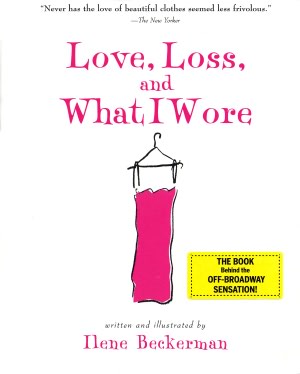
Ilene Beckerman's book...Love, Loss, and What I Wore

Love, Loss, and What I Wore by Ilene Beckerman is an unusual book. 

 Ilene coordinates her autobiography with her evolving wardrobe. She refashions “Where was I when...?” to “What was I wearing when...?” Beginning in the 1940s with her Brownie uniform, Ilene narrates her tales of love and loss to include education, dating, friendships, marriages, divorce, pregnancies, babies, social events, and shopping sprees. Perhaps, her affinity toward her outfits seems trivial. But no more so than recalling an amazing bistro dinner, a beautifully decorated hotel lobby, a breathtaking landscape, or a haunting movie as a means to recall our defining moments.

So I began to wonder, what's the overarching theme by which I review my life. Food? I remember a stew in northern Spain, a paella in Barcelona, steak frittes in Paris, escargot in Lyon, crab cakes in San Francisco, ahi tuna in O'ahu and Schweinshaxe in Germany. But these are just food memories not life memories framed through eating. Back to Ilene.

For Ilene, it's her appearance—hair, shoes, clothes, jewelry, and nails—that frames her experiences. She recalls what she wore during her milestones. Roughly sketched color pictures exaggerate her looks, creating a visual narrative of how she has embraced and weathered her life. Some of the details—like addresses –seem unnecessary, at first. Gradually though, they create an intimacy with this girl's coming of age and continued self-actualization. Notice how this simple description develops from the mundane to the poignant: “I bought this three-quarter-length long-haired raccoon jacket from Bonwit Teller's fur department in the Short Hills Mall. I had opened a charge account in my own name after I got a job and it took me a year to pay for the jacket. I was glad I had bought it, though, because after Al and I separated, money became tight.” P. 126 You get the idea. Recalling the outfit, Ilene recalls how she sees and saw herself.

I don't know why I bought the book. Probably a New York Times endorsement that, once again, had me falling in love with a book I wouldn't normally select.  I'm thinking of sharing it with my cousin Judy in the future because it may speak to her sense of fashion freedom. But for now, I'm keeping it to remind me that I see who I've become through my own frame of remembrances.

For you, what do you ask yourself during nostalgic moments...

“What was I reading when...?”
“What were the grandchildren doing when...?”
“Where was I traveling when...?”
“Who won the big game when...?”
“Where was I living when...?”

The overarching pattern—food, apparel, travel, reading, etc.--by which we recall our benchmarks speaks not only to our interests, but also, to our identity construction. Does our pattern indicate autonomy more than socialization? Does it favor appeals to pathos, logos, or ethos? Does it reveal pessimism, optimism, determinism, or opportunism? When I picture my life's major events, what is the frame of my pictures?

My memories are framed by my emotional reactions. Fear, anxiety, surprise, outrage, panic, and grief mingle with tranquility, excitement, appreciation, relief, and wonder. I remember how I felt waiting to see my brother come back from communion with his class only to suddenly realize that he had died the week before. I remember the fears of depression and the elations of mania. I remember the turmoil of my dissertation editing and the satisfaction of my PhD hooding.

I've fought all my life against my emotional nature. My father used to call me Sarah Bernhardt, so annoyed he would become over my dramatics. Criticized for being too emotional and too sensitive, I've often struggled to modulate my reactions. But if I remember my life through my feelings, am I not defining and living my life on an emotional level—for good or for bad?

How we frame our memories titles our personal self-actualization accounts. Your title might be Love, Loss, and How I Prayed or Love, Loss, and What I Wrote. My autobiographical title will be Love, Loss, and How I Felt.

Anyone interested in illustrating?